
Everything was shot in 10-second subs — 1,433 of them, just under four hours of integration in total.
| Target | Constellation | Integration | Filter | Captured |
|---|---|---|---|---|
| IC 1318A | Cygnus | 223 × 10 s (37.2 min) | LP | 3 Nov, 21:47 |
| M 45 | Taurus | 241 × 10 s (40.2 min) | IR-cut | 3 Nov, 23:00 |
| M 31 | Andromeda | 317 × 10 s (52.8 min) | LP | 4 Nov, 00:30 |
| IC 434 | Orion | 551 × 10 s (91.8 min) | LP | 4 Nov, 03:00 |
| 19 Aurigae | Auriga | 101 × 10 s (16.8 min) | LP | 4 Nov, 03:43 |
| Total | 1,433 × 10 s (238.8 min) |
IC 1318A — Cygnus
IC 1318 is a large diffuse emission nebula wrapped around Sadr, the star at the centre of Cygnus’s cross. IC 1318A is one of its brighter lobes, a mix of glowing gas and dark dust lanes.
This was the first shot I took facing the west. I actually had to zip tie a box of nails to one of the legs of the tripod. At 30° tilt the Seestar is almost on it’s side and will tip over the tripod just sitting there otherwise.
223 × 10 s · 37.2 min · LP filter · 3 November 2026, 21:47
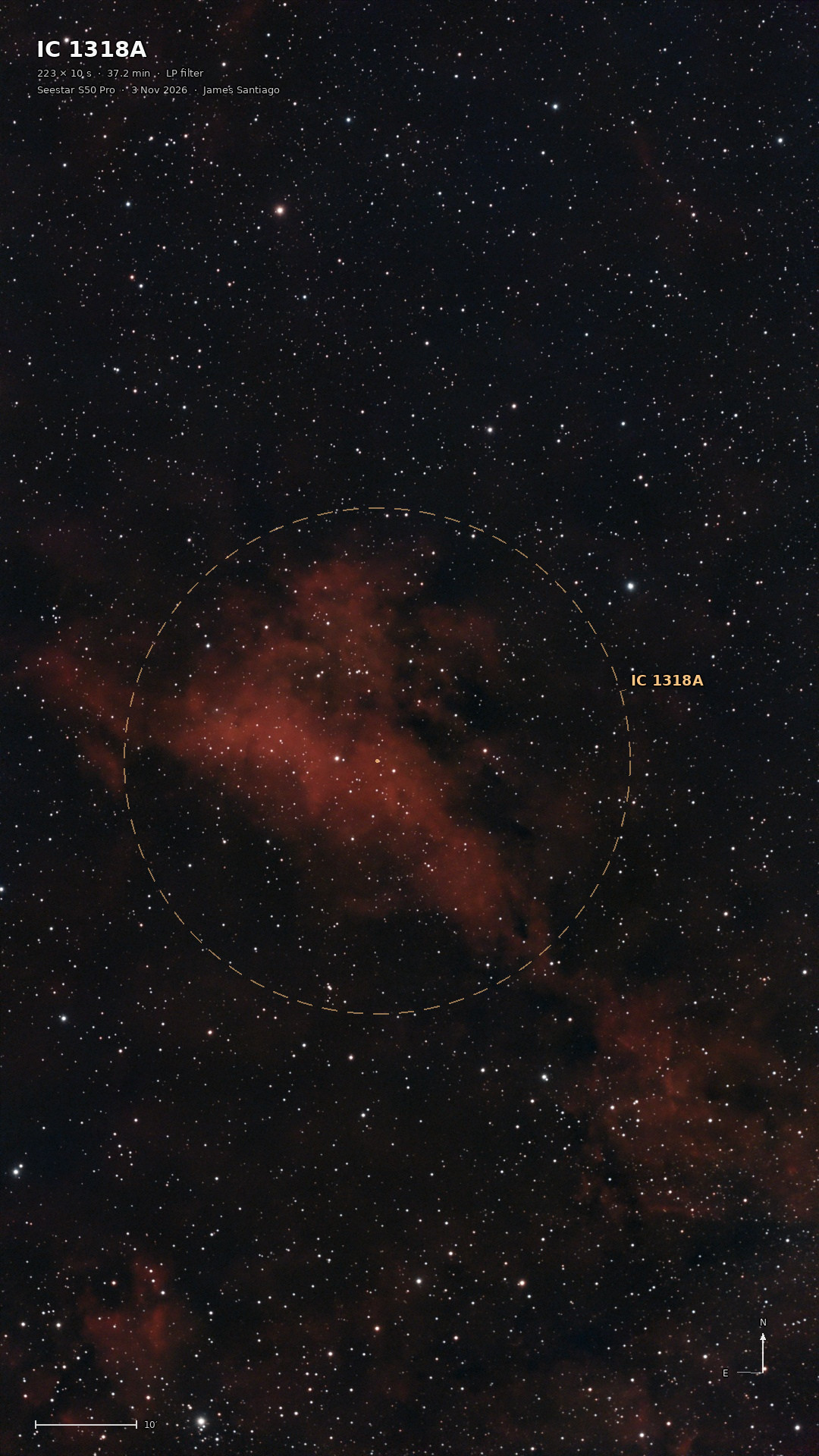 IC 1318A — 223 × 10 s, LP filter.
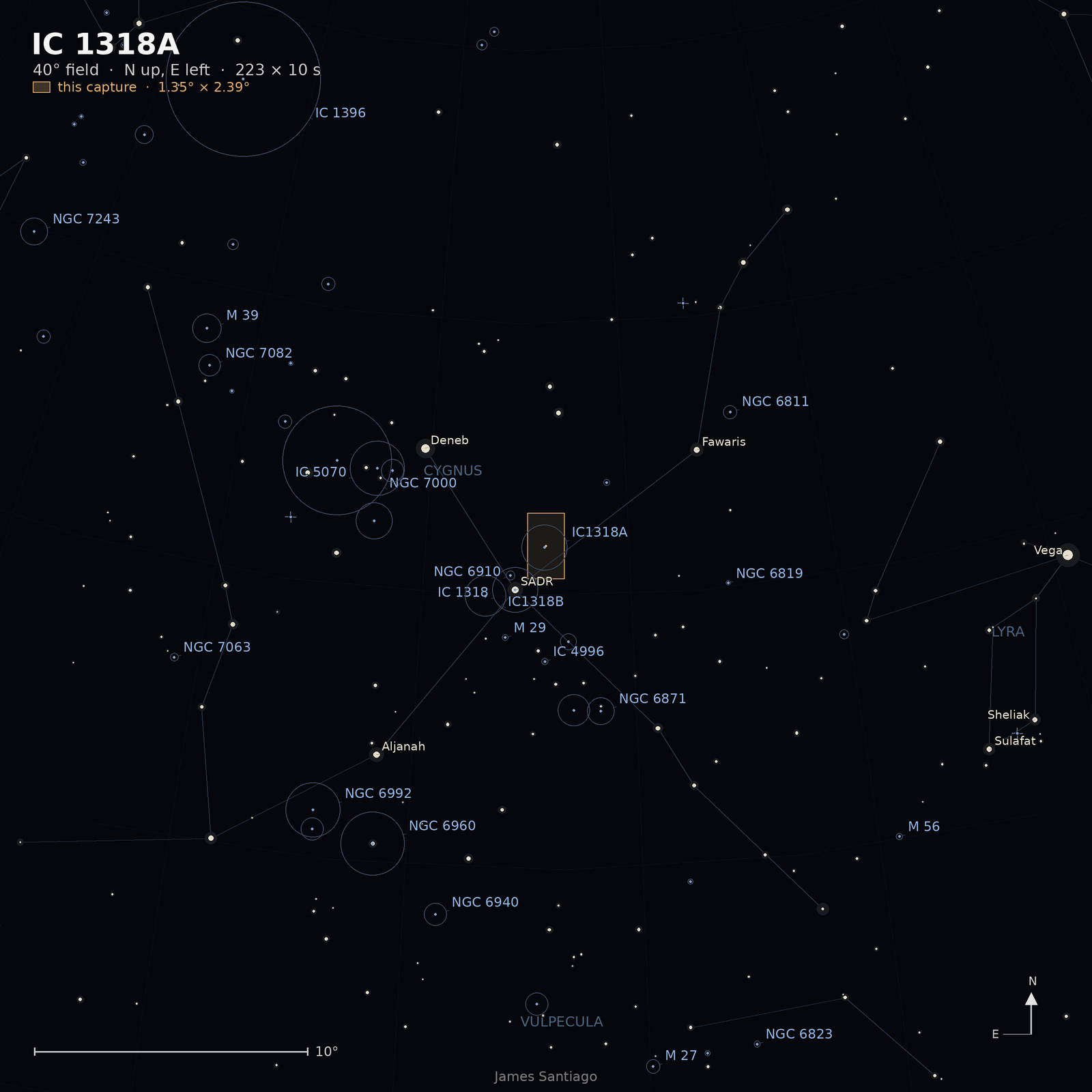 Where the frame sits: a 40° chart centred on the capture. North is up, east left; the amber box is the field.
M 45 — Taurus
The Pleiades, or Seven Sisters, is an open cluster of young B-type stars about 444 light-years away in Taurus. The blue haze around the brighter stars is reflection nebulosity — dust scattering their light.
Here I moved the Seestar to a new position and had to recalibrate it’s positioning. Takes roughly 5min, but necessary if I want to capture certain targets with the obstacles around my back yard. This one is to the east along with the rest of the targets.
This particular target is a favorite. It’s a nice cluster of stars that can be seen with the naked eye and has that nice blue reflection. Also referred to as the drumstick by the family.
241 × 10 s · 40.2 min · IR-cut filter · 3 November 2026, 23:00
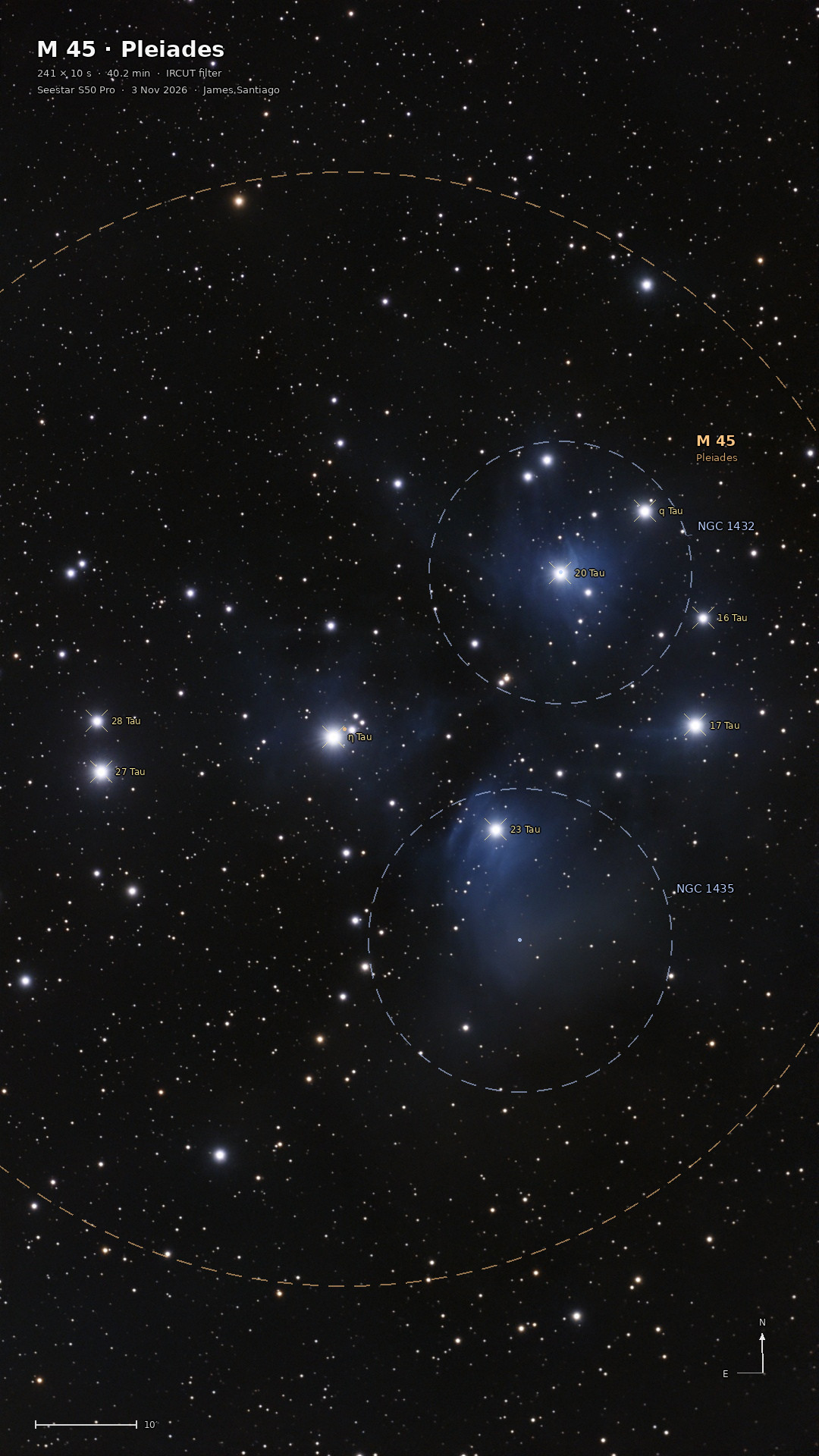 M 45 — 241 × 10 s, IR-cut filter.
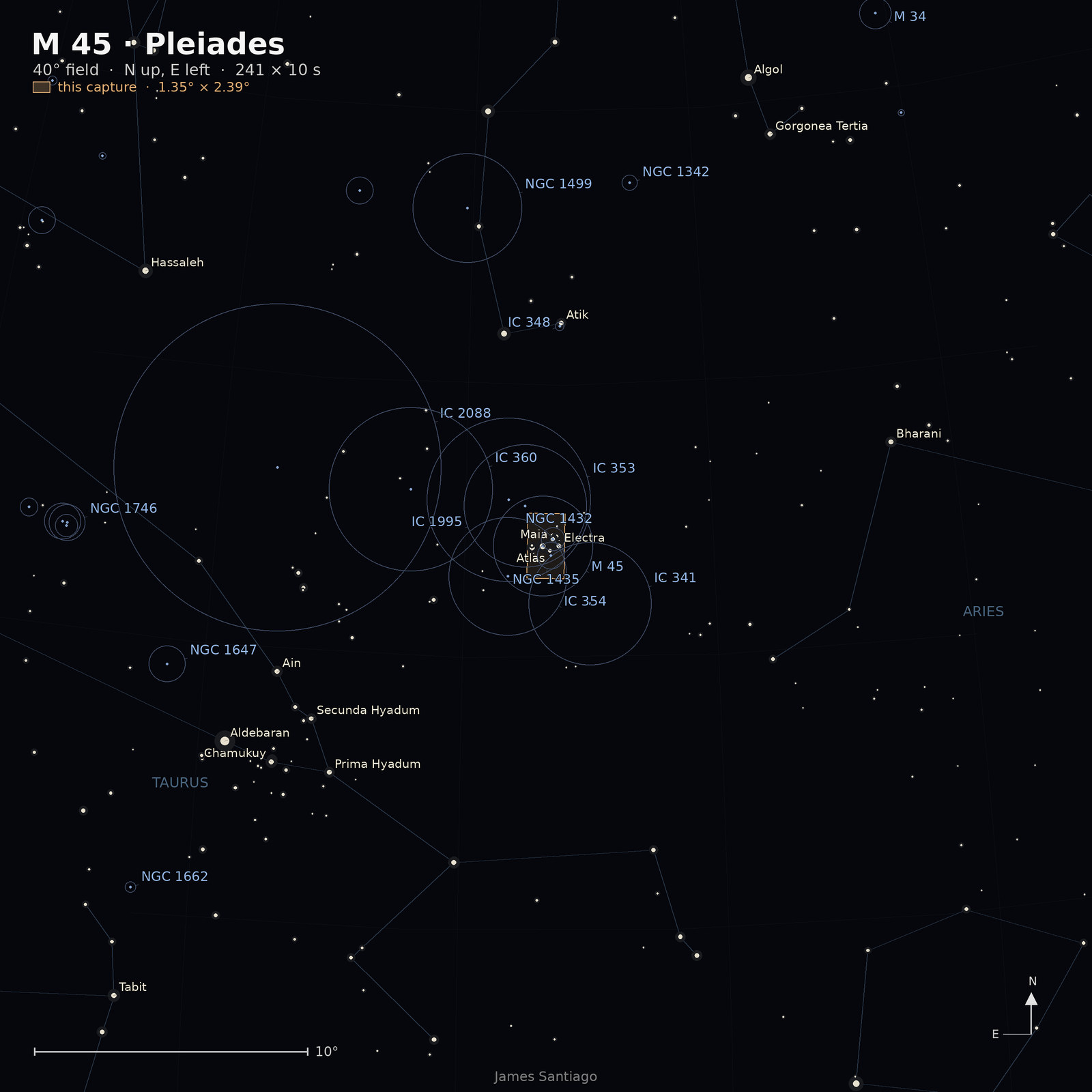 Where the frame sits: a 40° chart centred on the capture. North is up, east left; the amber box is the field.
M 31 — Andromeda
The Andromeda Galaxy is the nearest major galaxy to the Milky Way, a barred spiral about 2.5 million light-years away. M 32 and M 110, two of its satellite galaxies, are in the same field.
Here I setup a plan with Seestar to capture the rest of these targets automatically throughout the night.
317 × 10 s · 52.8 min · LP filter · 4 November 2026, 00:30
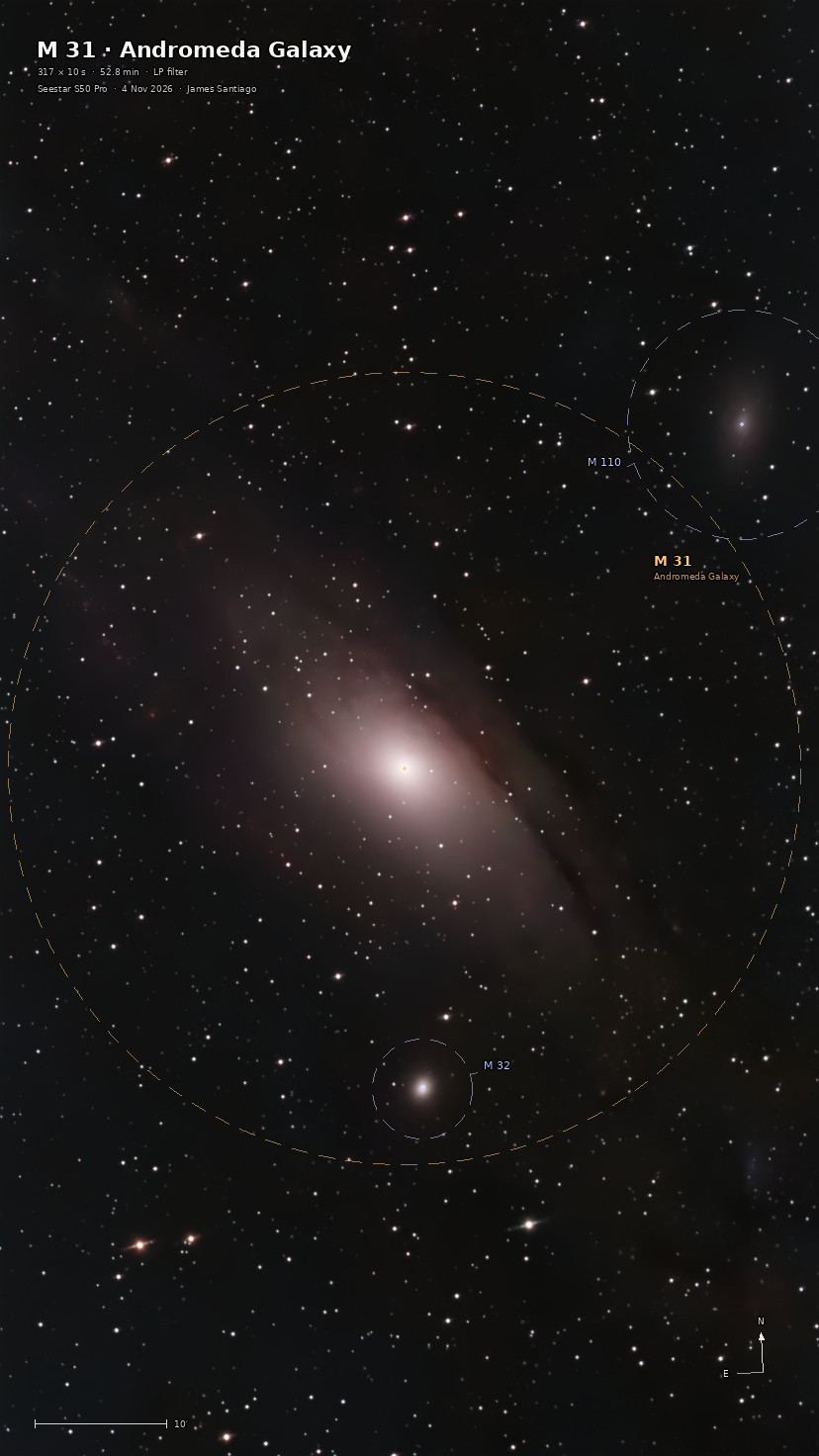 M 31 — 317 × 10 s, LP filter.
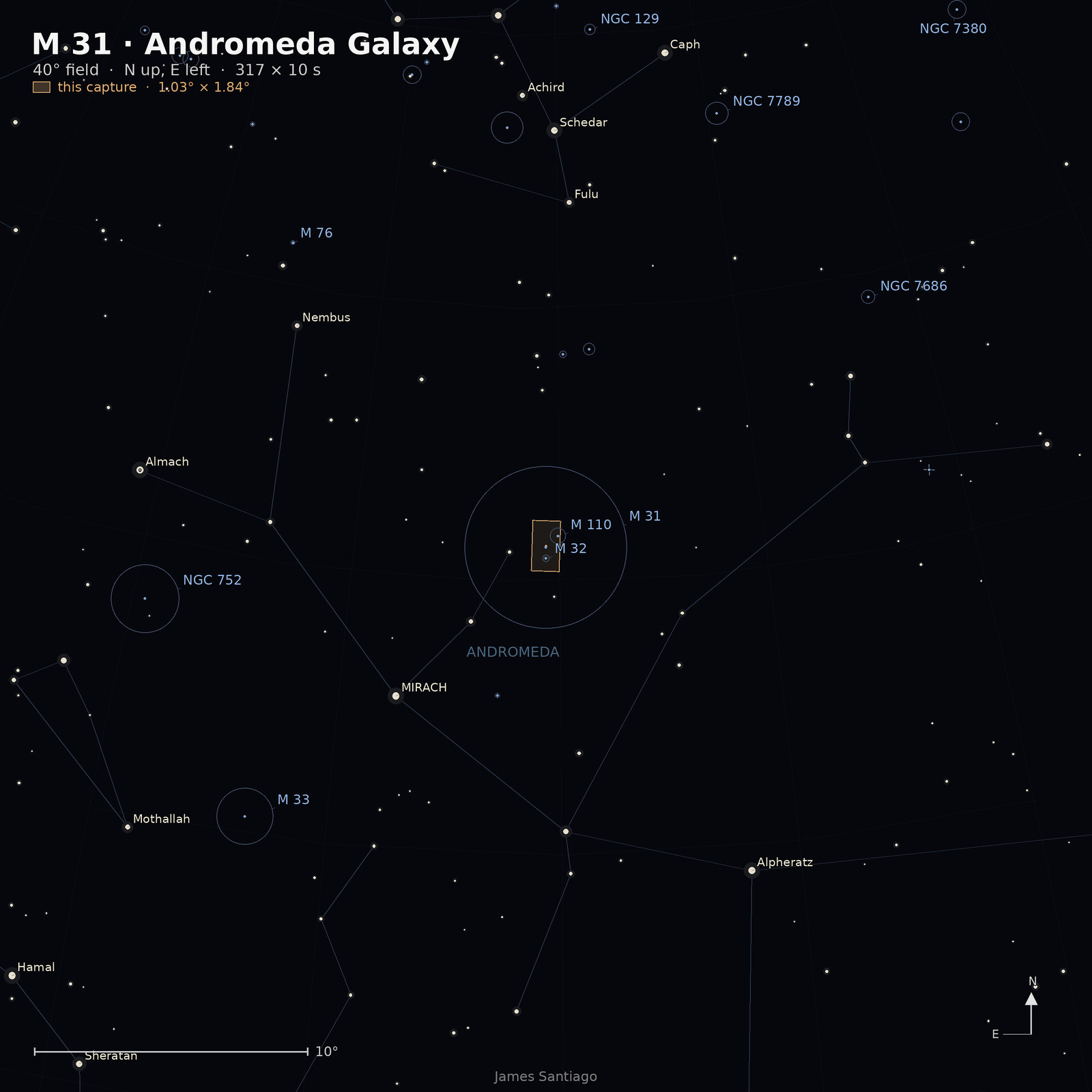 Where the frame sits: a 40° chart centred on the capture. North is up, east left; the amber box is the field.
IC 434 — Orion
IC 434 is the bright emission ridge in Orion that backlights the Horsehead Nebula, the dark plume of dust catalogued as Barnard 33 just south of Alnitak. The whole area is part of the Orion molecular cloud complex, about 1,375 light-years away.
551 × 10 s · 91.8 min · LP filter · 4 November 2026, 03:00
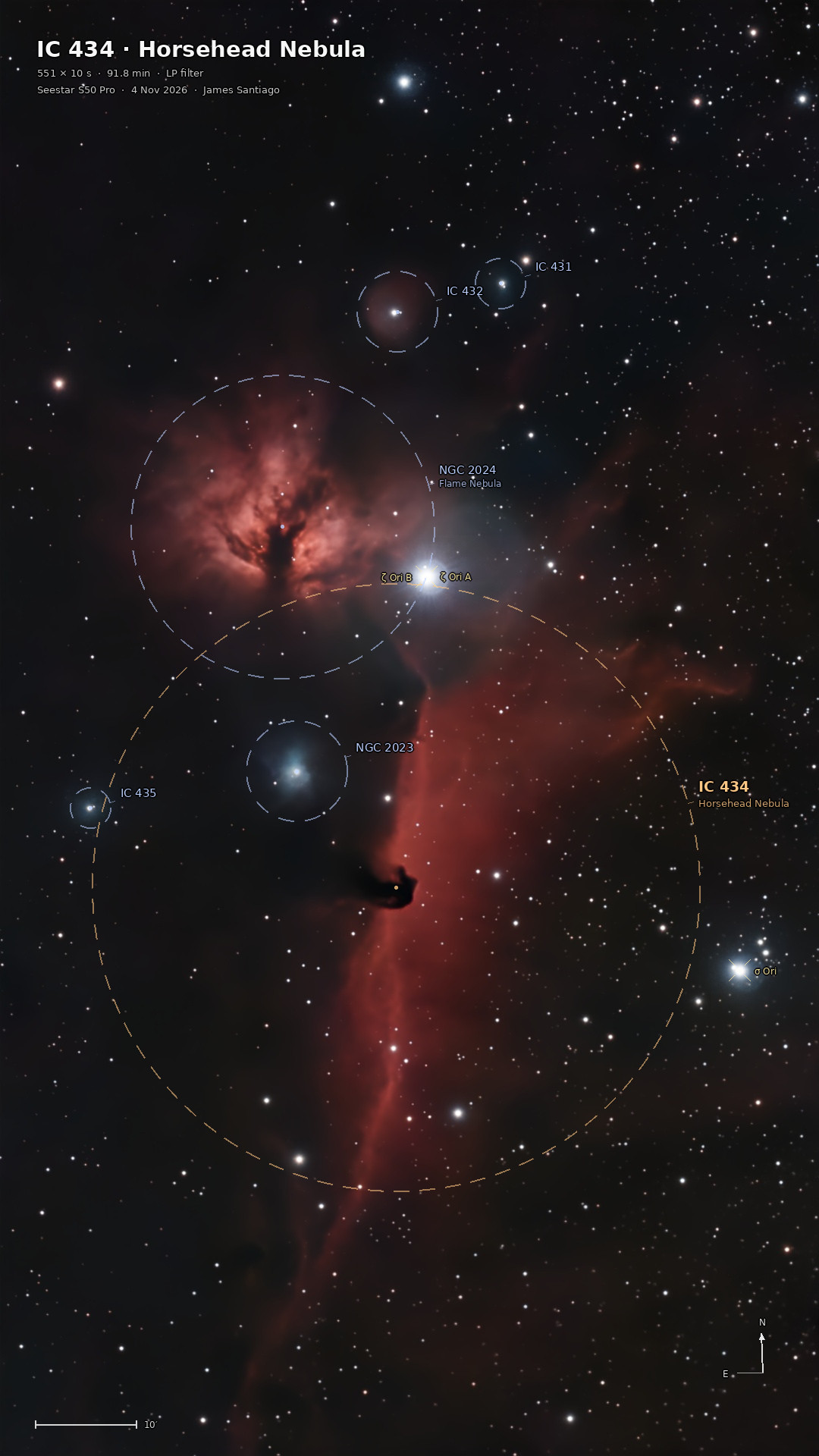 IC 434 — 551 × 10 s, LP filter.
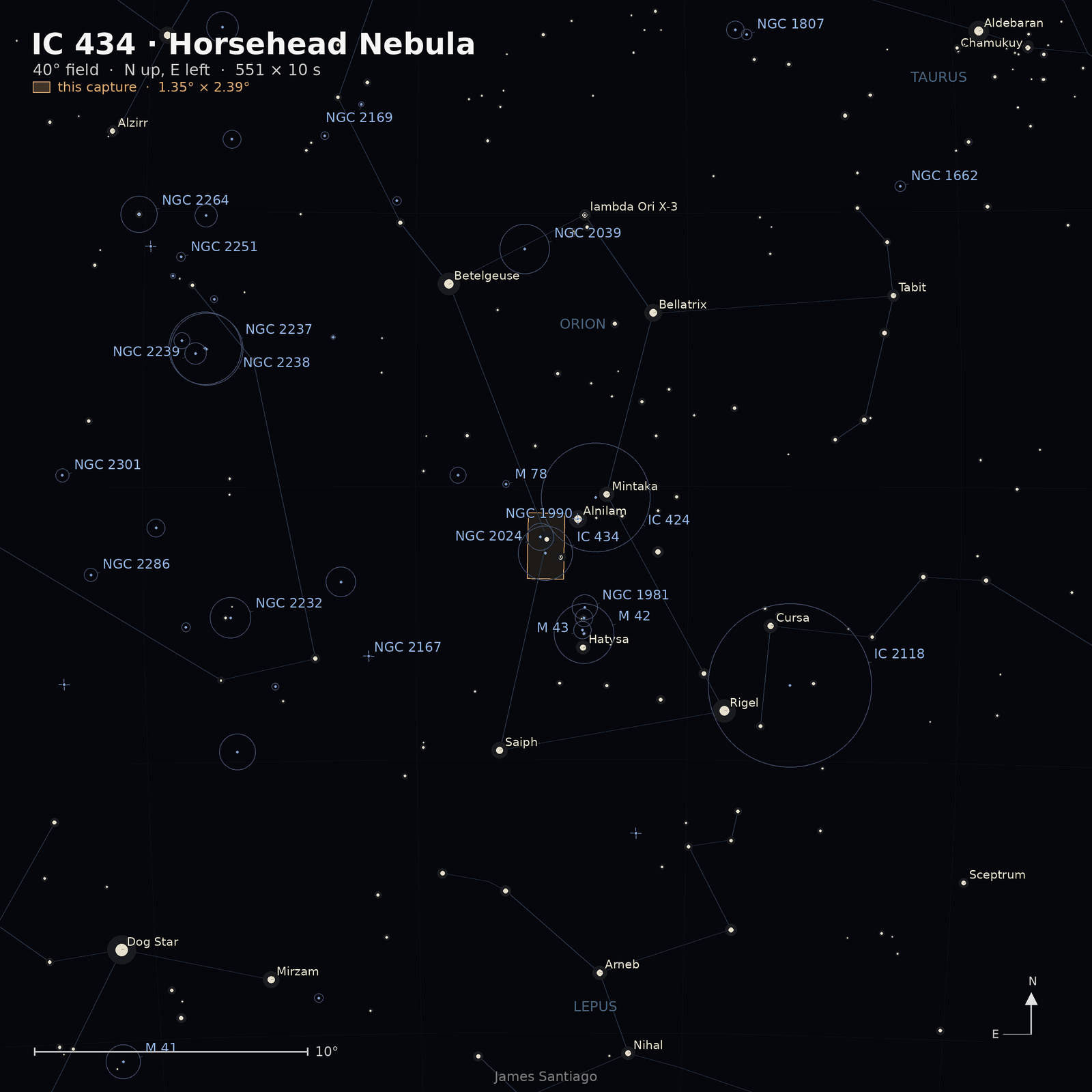 Where the frame sits: a 40° chart centred on the capture. North is up, east left; the amber box is the field.
19 Aurigae — Auriga (IC 405)
19 Aurigae is a faint naked-eye star in Auriga, about 3,800 light-years away. The frame is filed under that name, but most of the picture is actually IC 405, the Flaming Star Nebula around AE Aurigae; 19 Aurigae itself falls just outside the cropped export.
101 × 10 s · 16.8 min · LP filter · 4 November 2026, 03:43
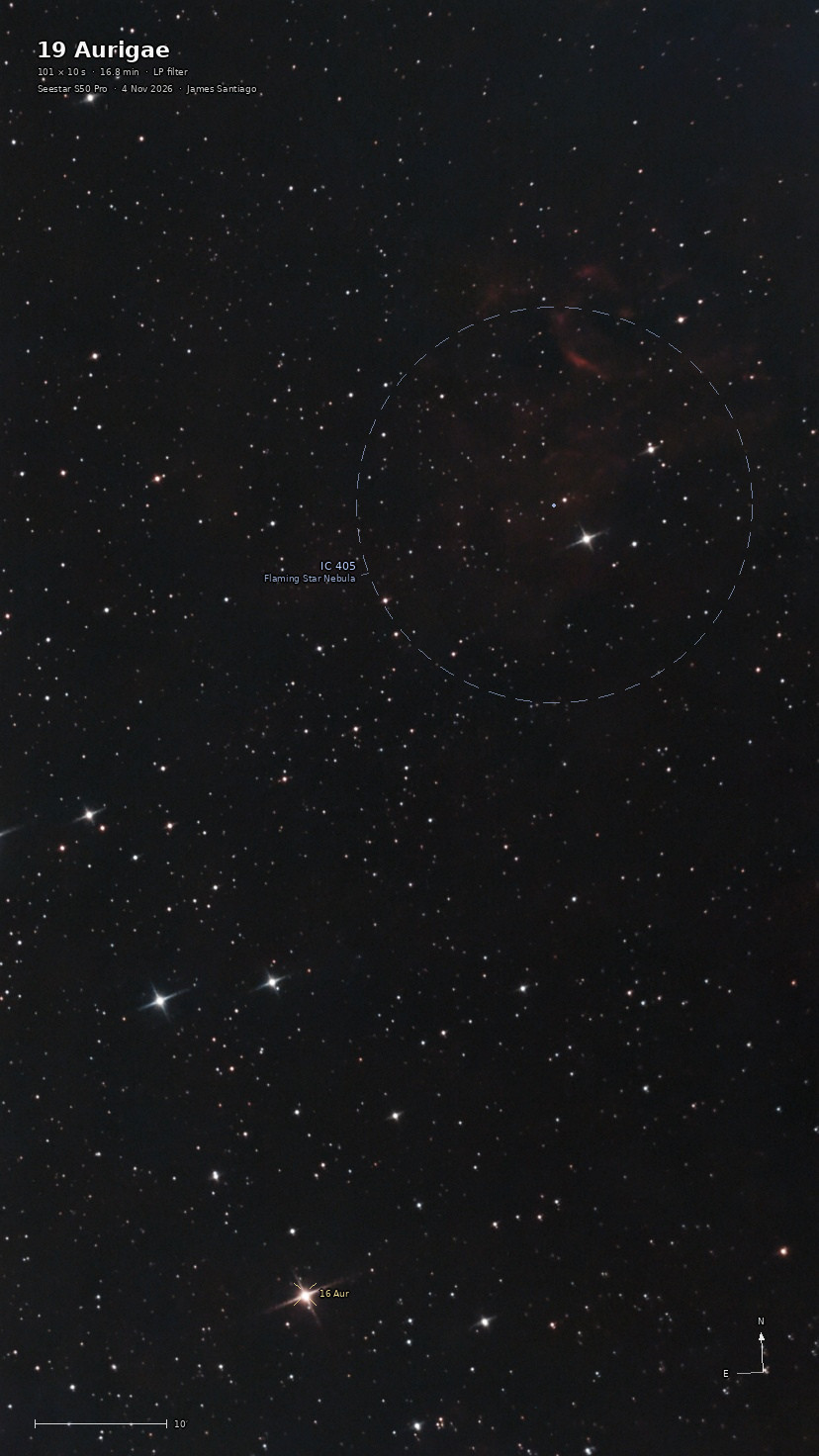 19 Aurigae field — 101 × 10 s, LP filter. Most of the frame is IC 405.
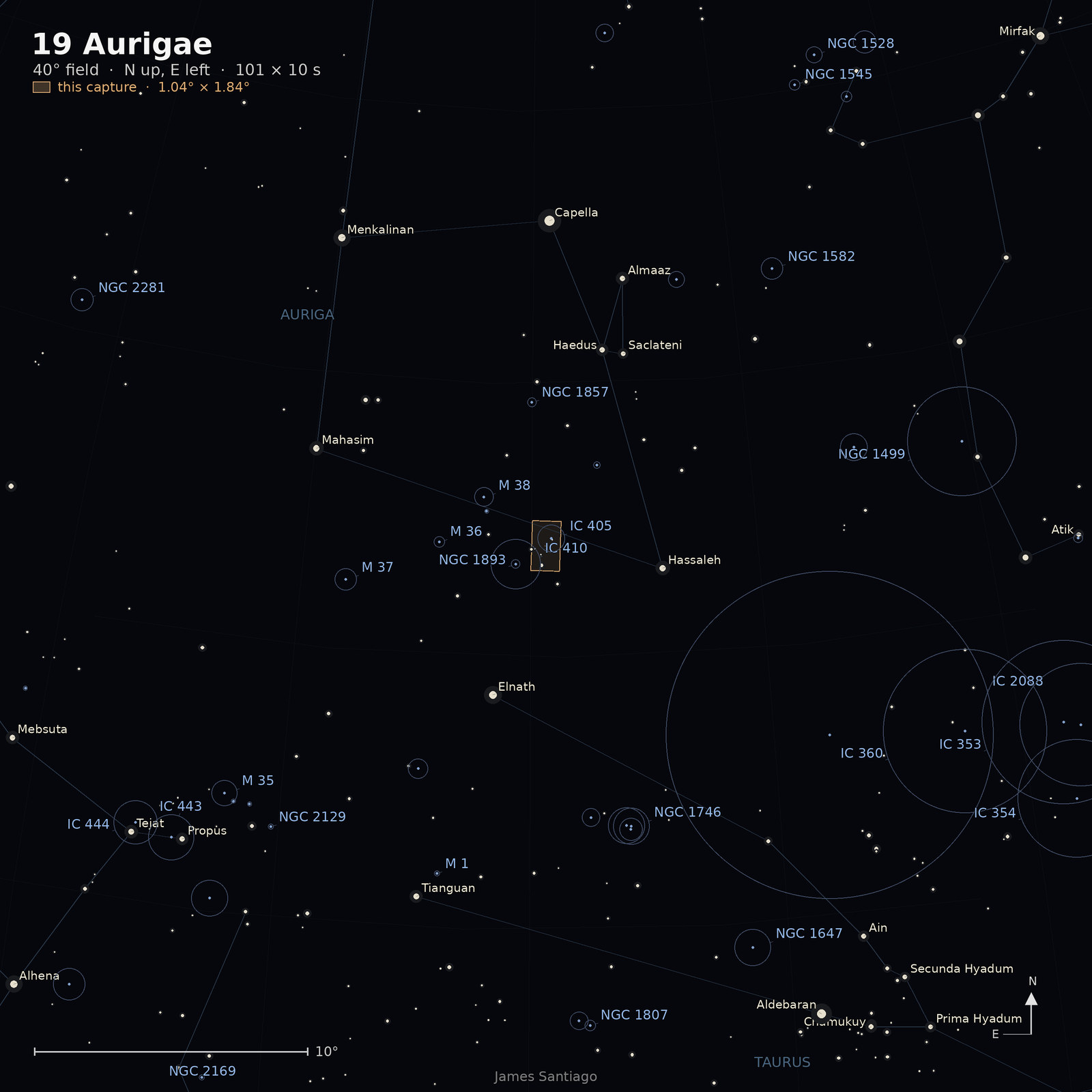 Where the frame sits: a 40° chart centred on the capture. North is up, east left; the amber box is the field.