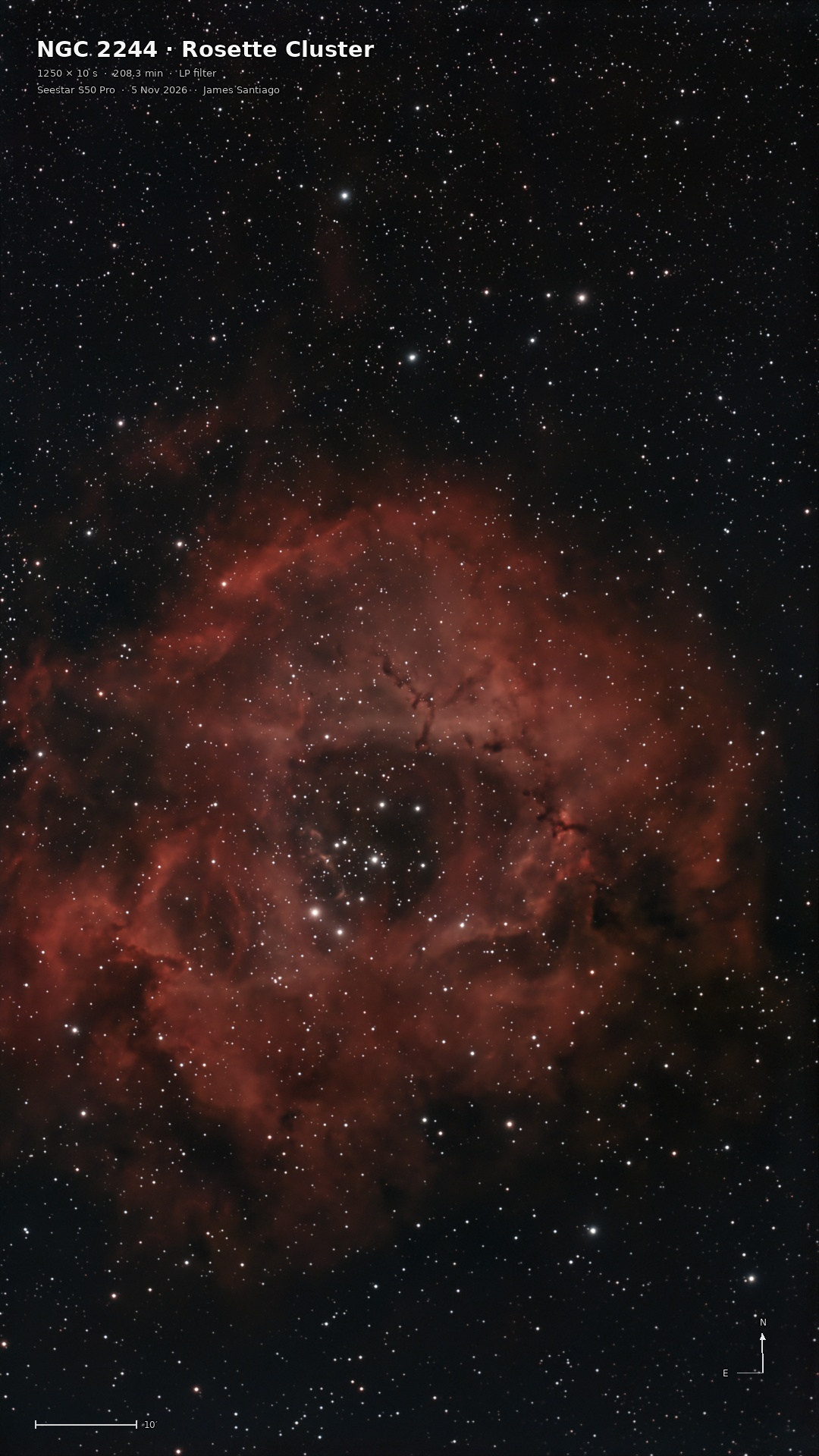
NGC 2244 — Monoceros (Rosette)
The long run of the night was the Rosette Nebula. The cluster at its centre is NGC 2244, a young open cluster whose hot O-type stars are what ionize the surrounding gas; the nebula itself is NGC 2237. The dark lanes cutting through the red shell are dust. At about 1.3° across, the Rosette fills the Seestar’s field neatly.
This was 1,250 subs, three and a half hours. The moon was a thin crescent and didn’t rise until 03:27, so the first half of the run was properly dark. From the east deck the Rosette transits at 65°, well clear of the southern treeline.
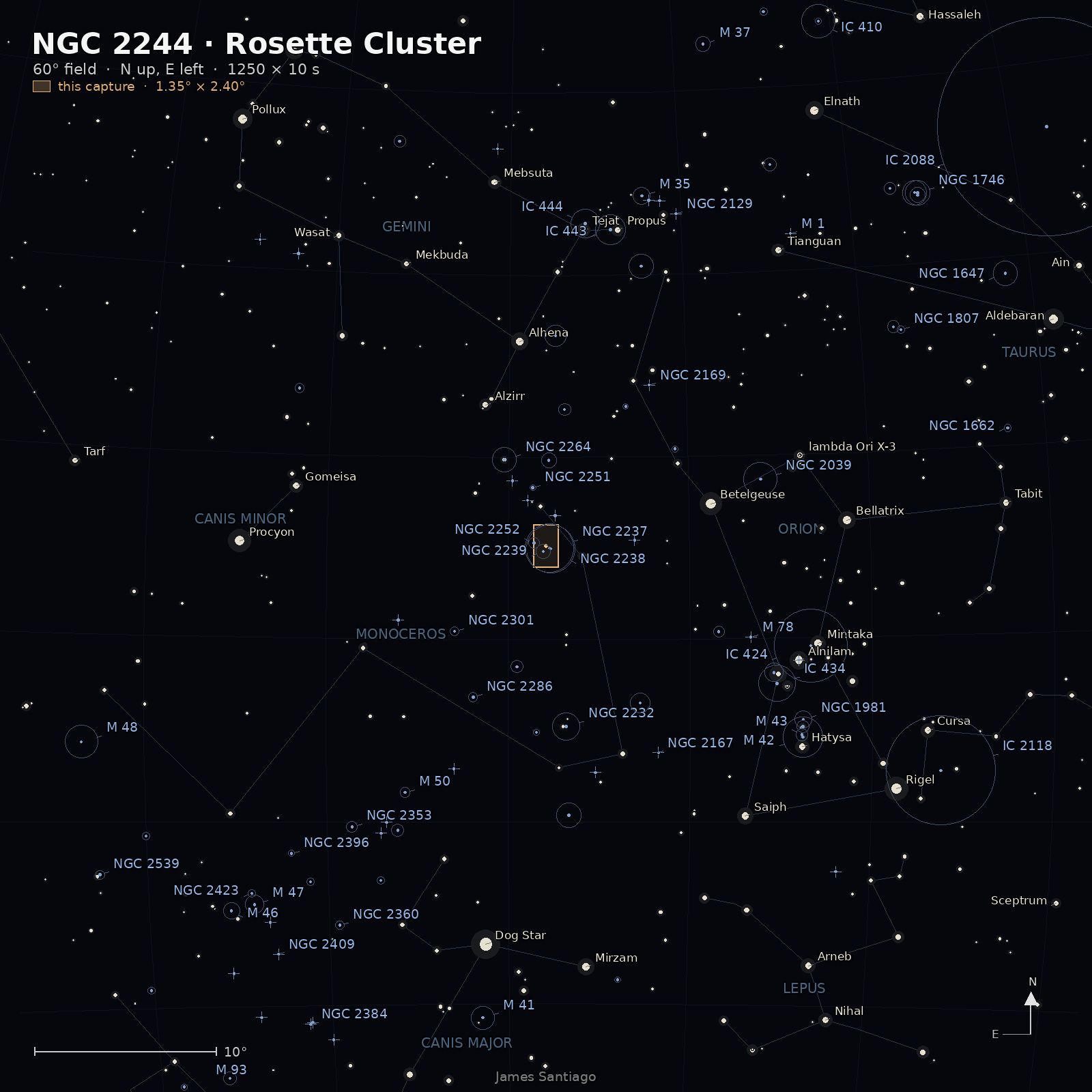
I left the object labels off this one — the frame is clean, and the 60° chart below does the identifying.
Some extras
I captured these targets as well as fillers while waiting for Rosette to rise.
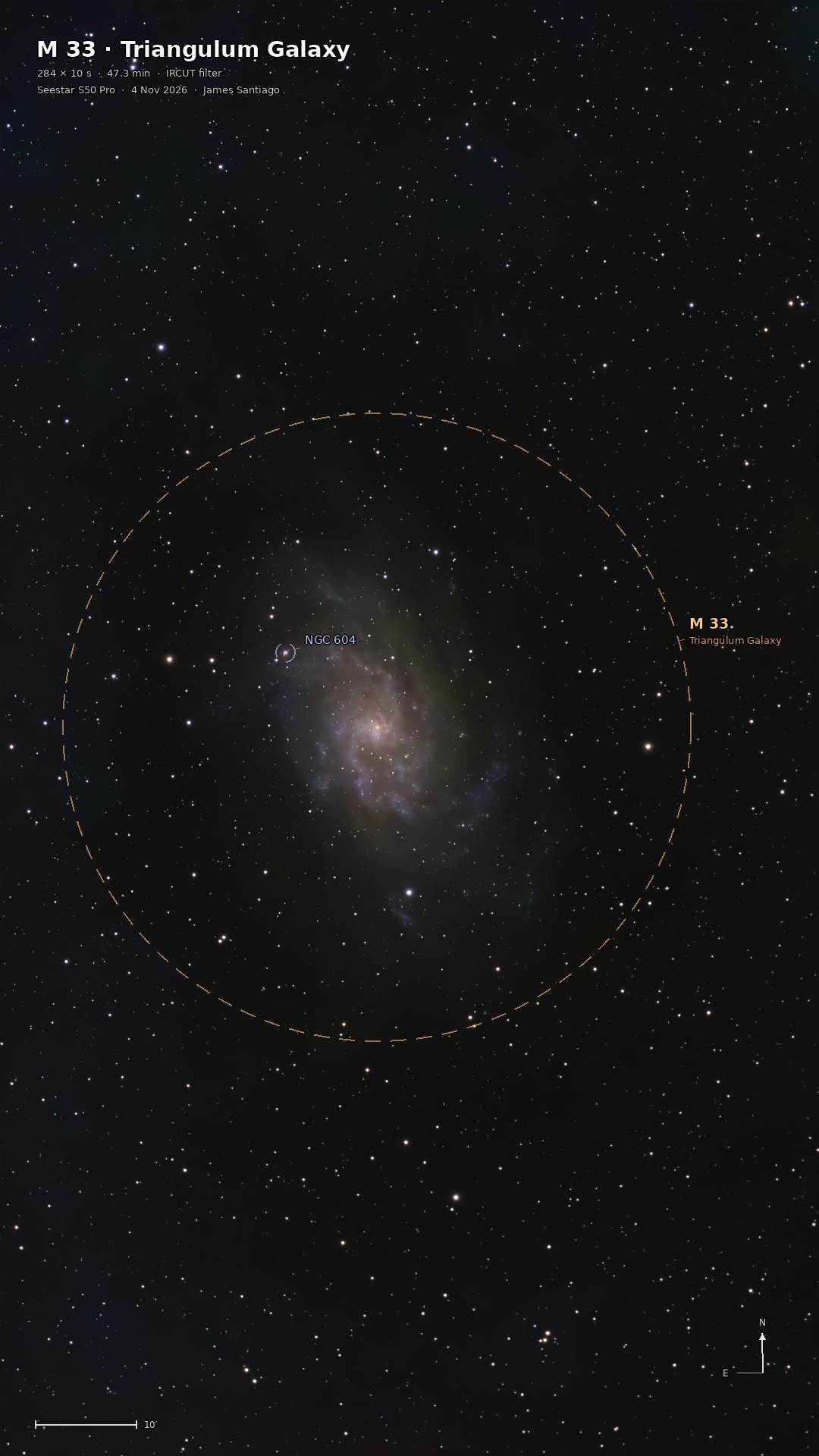
M 33 — Triangulum
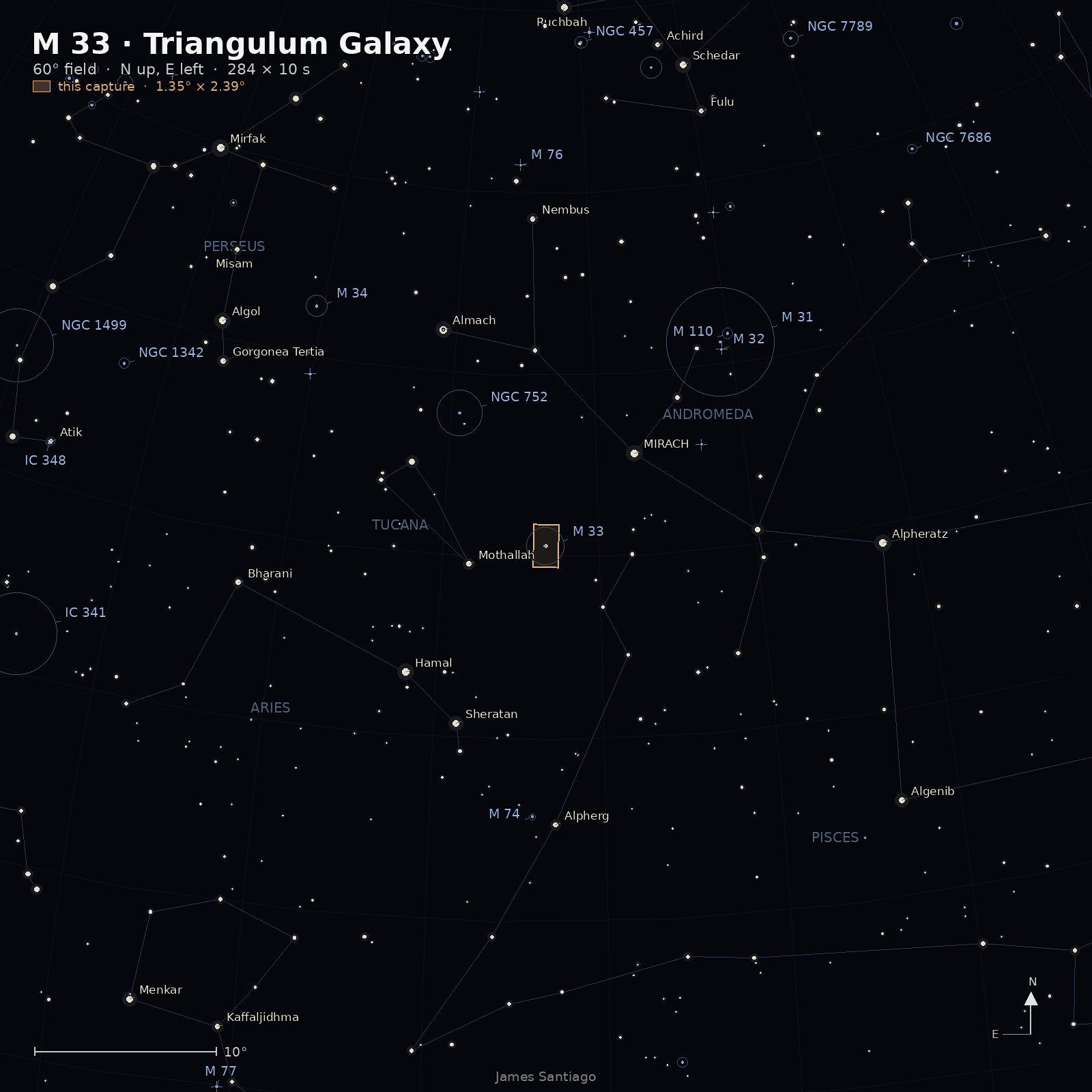
The Triangulum Galaxy is the third-largest member of the Local Group, about 2.7 million light-years away. It is a face-on spiral, which is the awkward kind of target for a small scope: the arms are large, but the surface brightness is low. I used the IR-cut filter rather than the LP filter and let the broadband light through.
The bright knot on the left side of the galaxy is NGC 604, one of the largest known H II regions — a star-forming complex about 1,500 light-years across.
C 28 — Andromeda (NGC 752)
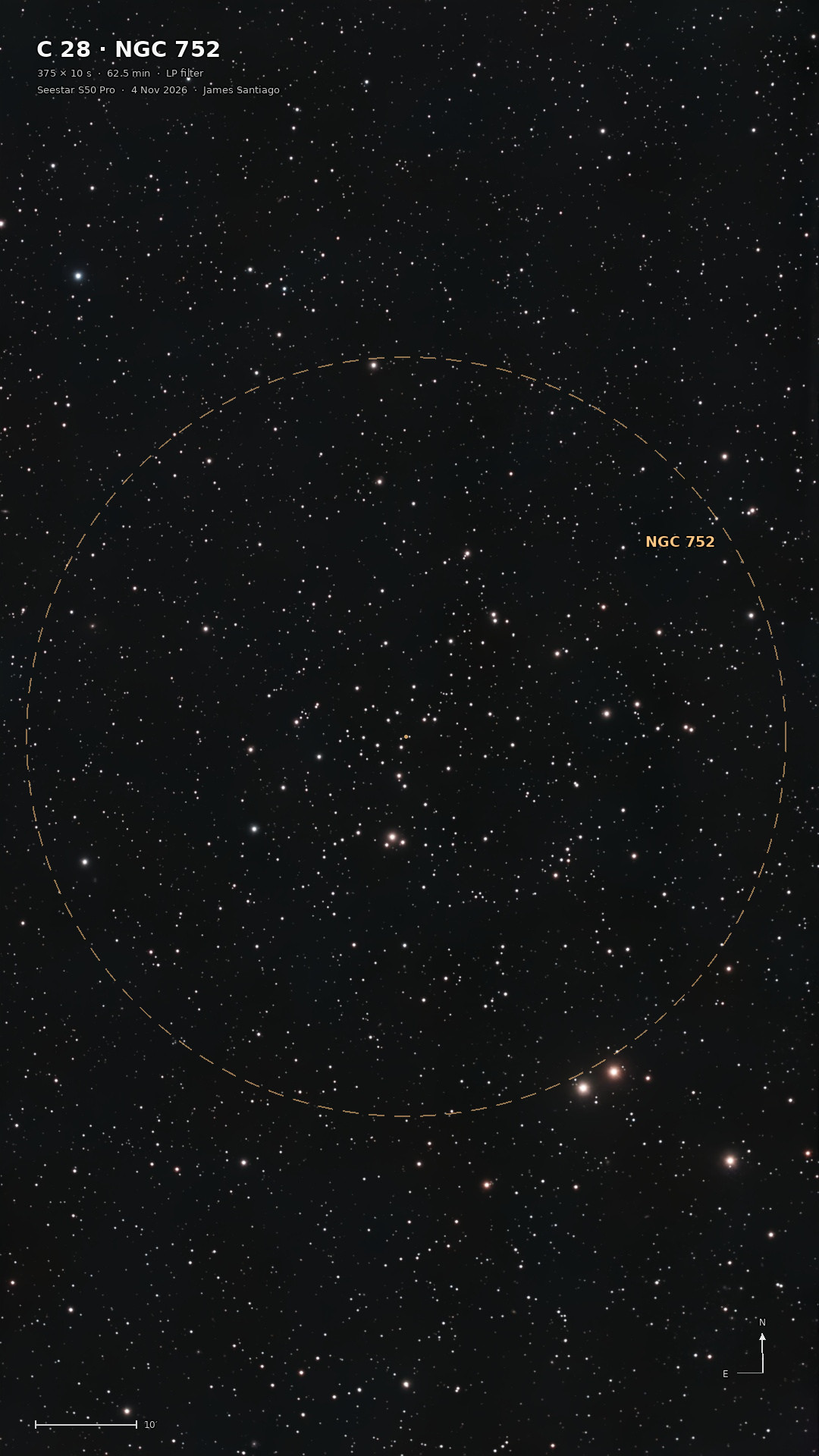
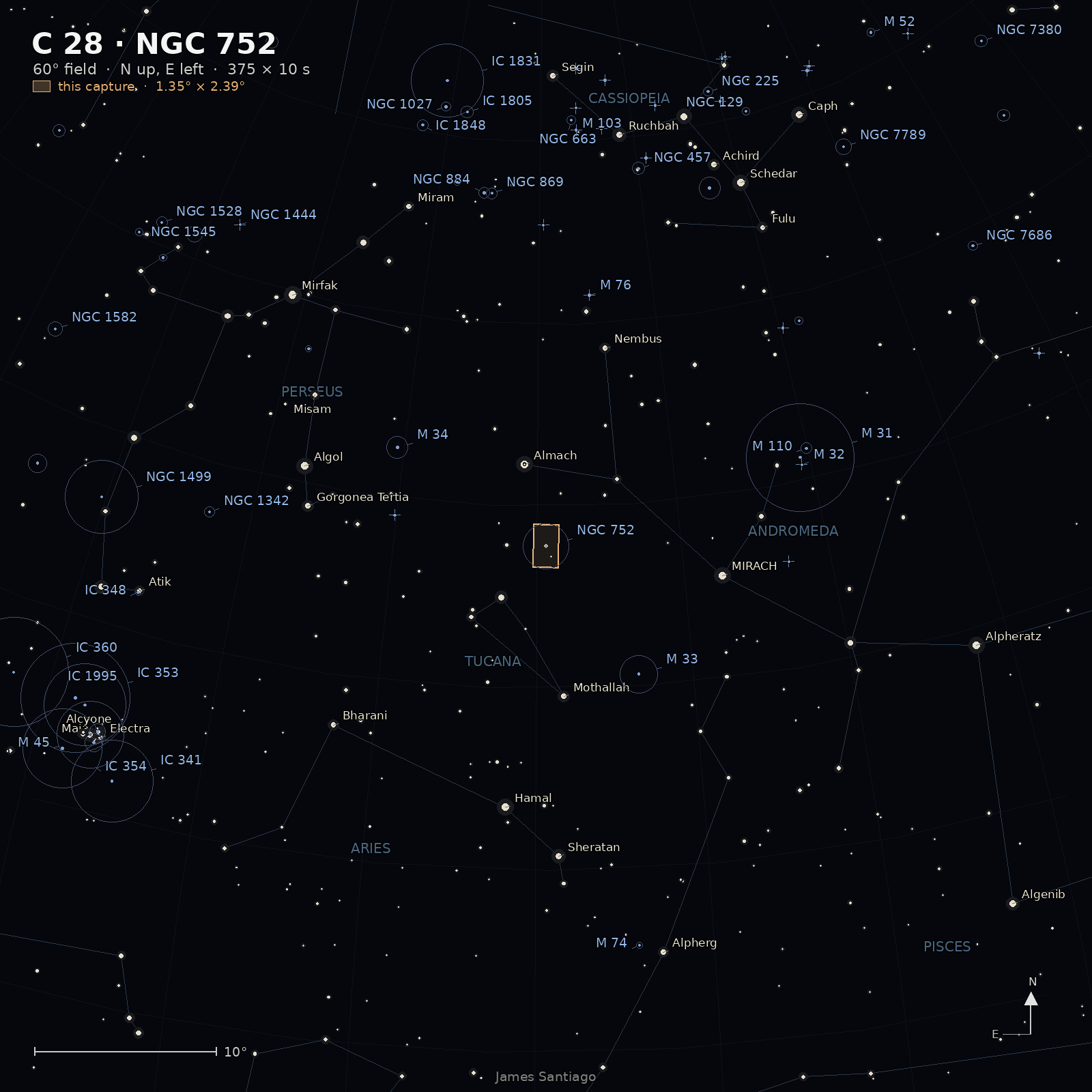
Caldwell 28 is NGC 752, a large, loose open cluster in Andromeda about 1,300 light-years away. It is a binocular object, and at roughly 75′ across it fills most of the Seestar frame. This was the short fill between M 33 and the Rosette — about an hour of 10-second subs.
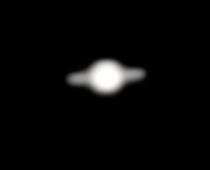
Saturn and Easy Imaged Stacker
One last item here is a capture of Saturn. I didn’t actually do this properly as the idea is to capture a bit of raw video for solar system objects and then stack the frames. Since I actually grabbed a non-raw mp4 I couldn’t use Seestar’s stacker and instead tried out Easy Image Stacker Image, a browser based stacker. My browser certainly didn’t like doing all this work and crashed on memory use. The result is also pretty bad, but that’s a bit more on the capture settings I used and general limitations of Seestar’s aperture.